

He spent decades certain that carrying the weight was the whole job. Then he found out his friends would have wanted something else from him entirely.
This community shows up for each other. That part is ordinary here. It is how the place works.
The morning of the eleventh was different from the start.
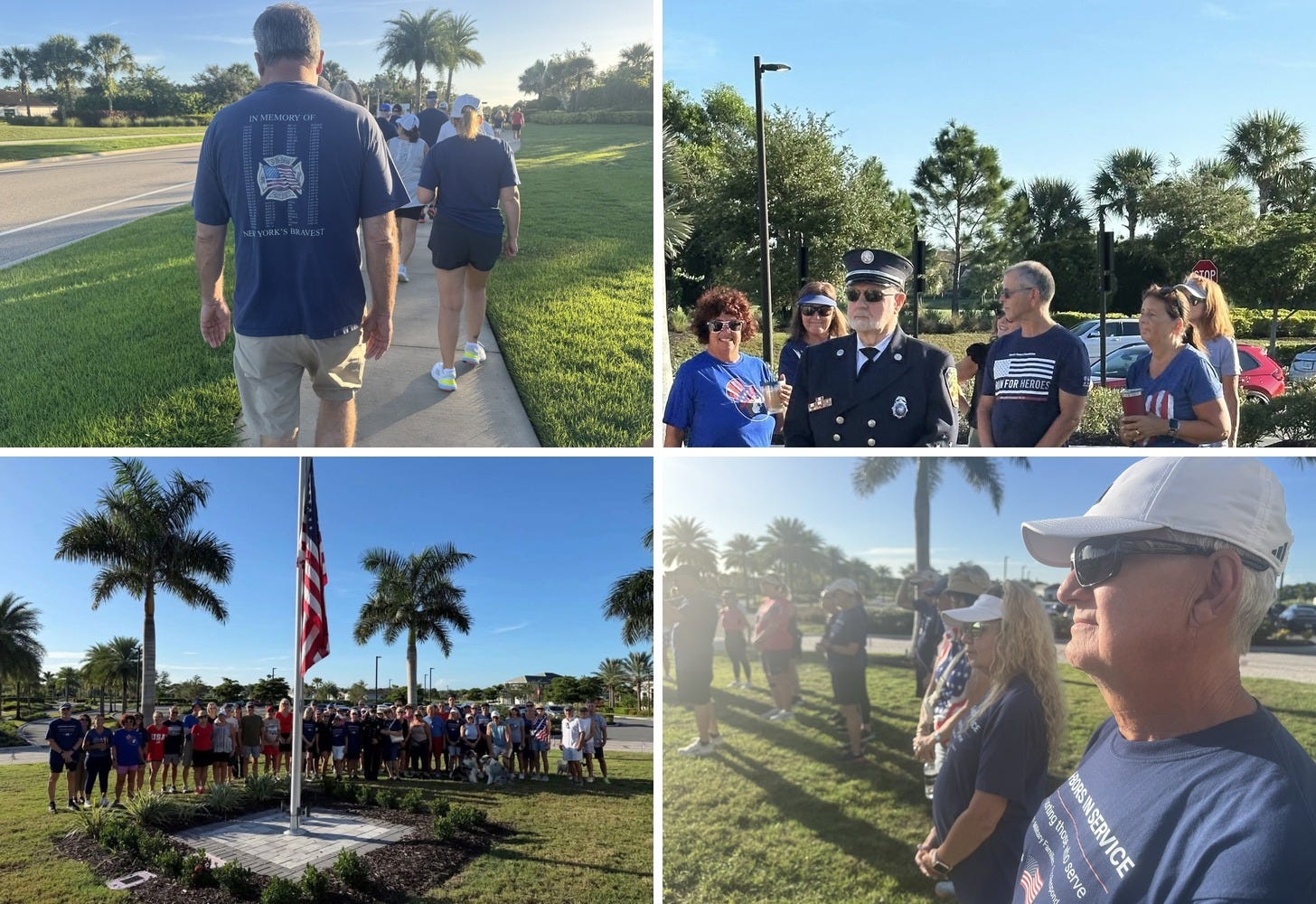
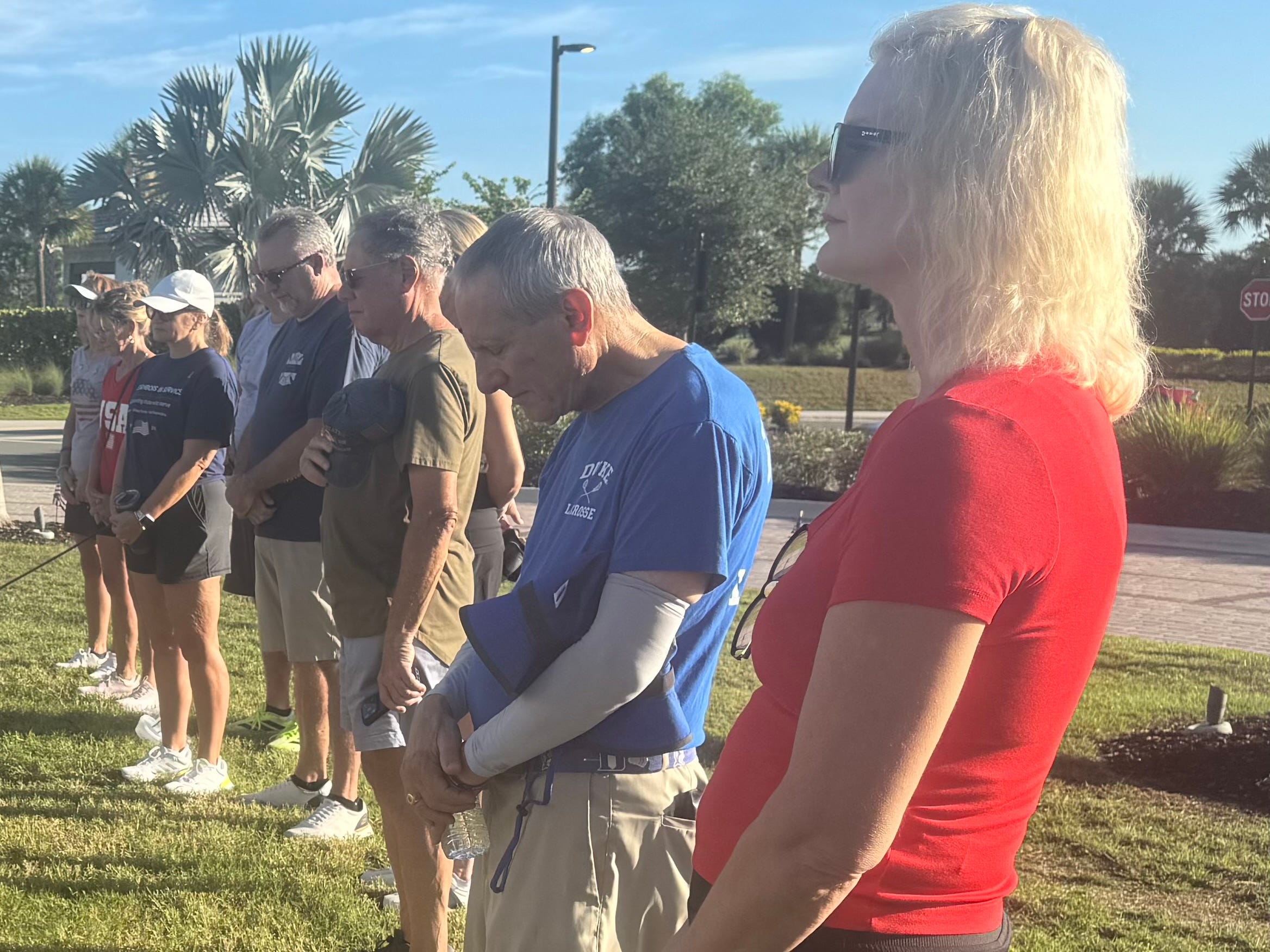
We walk these streets most days of the week. On the eleventh we walked the same route, and it was not the same walk. The sun was barely up. The flag stood at the top of its pole the way it does every morning. More than fifty of us came.
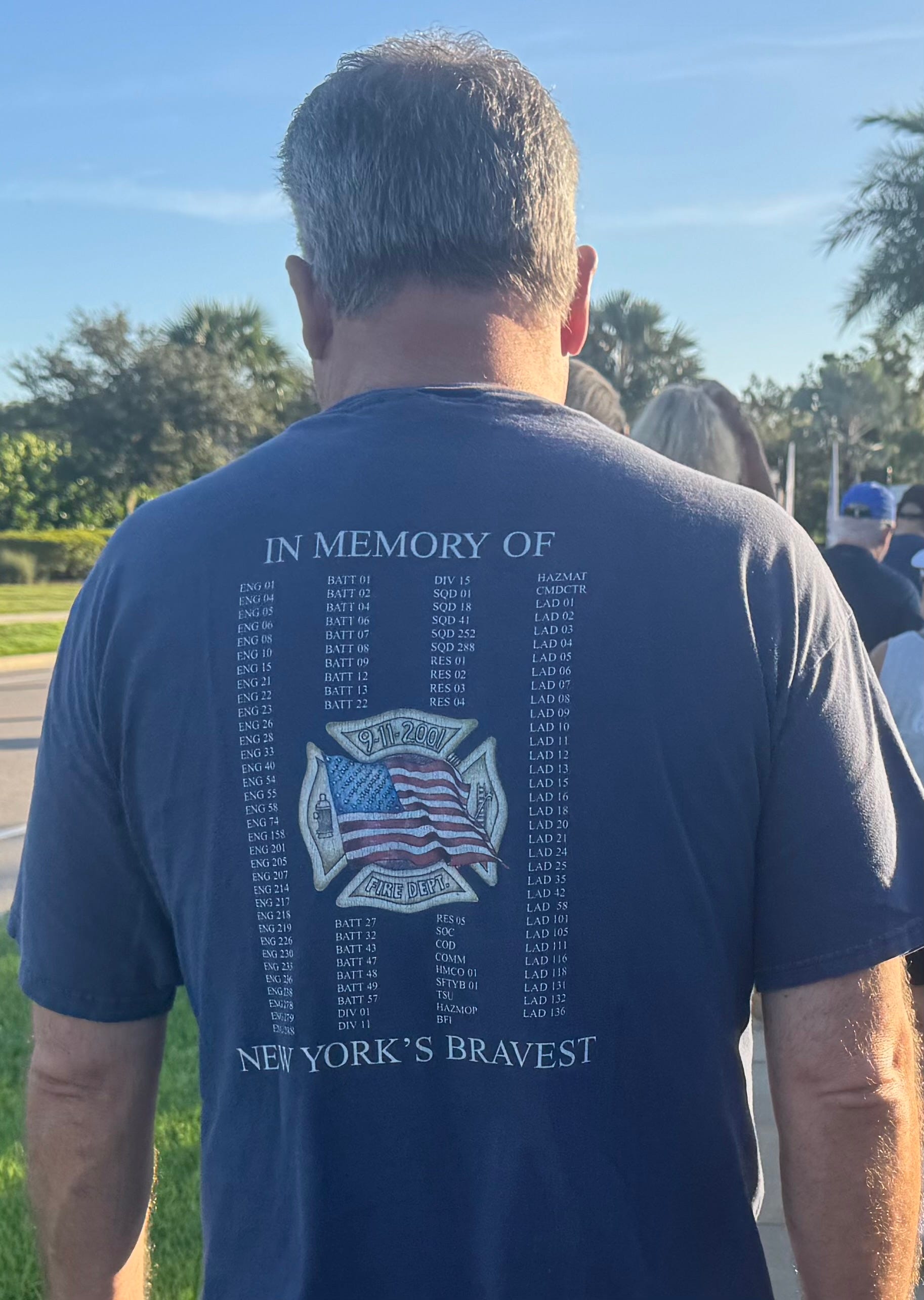
One man wore his fire department dress uniform, buttoned to the collar, and stood in the grass while the rest of us stood around him in running shoes. Others wore shirts with the name of every company that lost men that morning printed down the back.
Then we lowered the flag to half-staff, and everyone stopped talking and looked at the ground.
It was a warm morning. The warmth that mattered came from being together.
Some of our neighbors were up early again the next day, driving south to Fort Myers for the Tunnel to Towers race.
Somewhere in that same week, a retired New York firefighter was doing what he has done every September since: saying his friends’ names out loud so others will hear them.
His name is Tim Brown. He lost ninety-three of them in a single morning.
THE MEN HE LOST
Brown joined the FDNY in 1984 and spent more than a decade with Rescue 3 in the Bronx. By September 2001, he had been detailed to the Mayor’s Office of Emergency Management, working out of 7 World Trade Center. He was eating breakfast on the third floor when the first plane hit. He went into the North Tower lobby, then the South, and was outside looking for paramedics when the South Tower came down on top of the hotel he ran into.
His memoir, The Greatest Love, came out in August. It is not a book about that morning. It is a book about the twenty-five years since, and about what he got wrong for most of them.
We sent him ten questions. He answered all ten.
Captain Patrick Brown, called Paddy, ran Ladder 3. He was a former Marine, and struggling firefighters often ended up assigned to his unit. At his memorial service, a line of children walked single file through the funeral home, each with a hand on the shoulder of the child ahead. They were blind. Paddy had been their karate instructor. Nobody at work had known.
You only learned about Paddy Brown’s karate class at his funeral, from a line of blind children who came to say goodbye. What did you learn about who your friends really were only after they were gone?
I think I knew he practiced Karate, but certainly had no idea he taught Karate to blind kids in his spare time. There was a lot about Paddy that I didn’t know. I think he learned as a kid to keep things to himself to protect himself. He knew how to compartmentalize. Even when it came to relationships. He had different friends/lovers and never talked about it with others. This is evidence in his handwritten will, where he says that everyone will say they were his best friend, so he wrote who his best friends were in the will. Most died with him.
A distinction runs underneath the whole book, and Brown states it once in the introduction without explaining it. He understood immediately that his friends had been doing their jobs and keeping an oath. It took him decades to understand what they did as an act of love.
You write that you always understood your friends were doing their jobs and fulfilling their oath, but that it took far longer to come to terms with what they did as an act of love. What was the difference between those two ways of seeing it, and what moved you from one to the other?
That transition in my understanding of what they did took decades. Back then, I remember Mayor Giuliani saying that 9/11 was the “worst day of his life” AND “the best day of his life.” I was SO ANGRY at him for saying that when our friends were still in the rubble. But Rudy was right. He saw back then what took me so long to understand. Each one of the first responder heroes CHOSE to go up those stairs because people needed them. They knew they likely were not coming back. They still did it! In one case, Firefighter David Weiss from Rescue 1 went back up TWICE.
WHAT HE GOT WRONG
For most of the years that followed, Brown believed that honoring the dead meant carrying them heavily. That grief was the receipt. That if he ever put the weight down, it would mean he had stopped loving them.
You write that for years you thought honoring your friends meant carrying their memory like a burden, that suffering proved your love and emptiness honored their sacrifice. Then you say plainly that you were wrong. What changed?
They would want me to live a full, joyful, happy life. It just took me a long time to realize that. Some people use the word “closure,” which I am not a fan of. We never have “closure.” What we do is learn to carry our pain and grief ALONG WITH creating new life, love, joy and happiness alongside it. It’s similar to PTS, which is a physical manifestation of brain nerves. Some of the successful treatments slow/stop and even reverse the physical “bad” nerve growth. We can’t reverse our memories, but we can compartmentalize them and allow room for new “good” memories to grow.
That image of memory as something that can be crowded out by new growth is his, and it is worth sitting with. He is not describing a cure. He is describing making room.
He got a second thing wrong, and it is the one our readers will recognize fastest. For years Brown believed his own story did not count. The families had lost husbands and fathers and sons. He had lost friends. He decided that put him in a lower tier, and he kept silent.
It changed because of a woman named Debra Burlingame, whose brother, Captain Charles F. “Chic” Burlingame III, was the pilot of the plane that hit the Pentagon. She began saying “9/11 families and survivors” instead of “9/11 families.” Brown heard it as an invitation.
For years you believed your story was secondary to the families who lost a blood relative, and you write that the thinking kept you trapped. What would you say to someone who has concluded that their own loss, grief, or struggle does not qualify?
My good friend and widow of Sergio Villanueva taught me that it’s ok if you speak YOUR TRUTH, even if someone else doesn’t like it or see it that way. But I remember exactly when I felt empowered to speak my truth alongside the families. That was when Debra Burlingame (sister of 9/11 hero Captain Chic Burlingame) started saying “9/11 Families and Survivors.” That gave me permission, in my mind, to speak out about my story and pain and guilt. When/if you are ever in difficult situation, take a step back and assess the situation and all the people affected. There is great power in empowering those affected and building that tribe, even if it’s a tribe of grief. Humans were meant to be social. Embrace it. Lead it. Don’t sit back and wait for someone else to do it.
Read that again if you are the person in our community who has decided your thing does not qualify. The veteran who never deployed. The spouse who stayed home and held it together. The responder who was on the other shift that night. Brown spent years in that position, and the thing that got him out was somebody else changing the words.
WHO REACHED HIM
Brown went through at least ten therapists. He was not looking for medication, which several of them led with. He wanted somebody who could explain what was happening to him and give him something to do about it.
What finally worked did not come from a directory. It came from Tanya, whose fiancé Sergio Villanueva of Ladder 132 was killed that morning along with his entire company.
You went through at least ten therapists before Tanya pointed you toward Ashley. What difference did it make that the referral came from someone who knew you and knew what you had lost?
Tanya and I formed a deep connection very early on. I think we both needed someone to walk the unknown path with, together. When she saw me struggling so much and she knew she was making progress with Ashley, she went to Ashley and asked her if she would take me on, as it got close to ethical questions that may be asked. Luckily, Ashley agreed to see me. She also knew when I was finished and she “fired” me.
Notice what actually happened there. Somebody who knew him well enough to see he was struggling did not tell him to get help. She arranged it and checked whether it was even allowed.
The second person who reached him had no idea what she was doing. Debora, called Debs, tended bar at an Italian restaurant he went to so he would not have to eat alone. She learned his name. She asked how he was and cared about the answer. One night she asked what he was doing later.
Debs was a bartender who noticed you were coming in alone and invited you out. She had no connection to the fire service and no way of knowing what you had lost. What did she do right that people who knew exactly what you had lost could not?
Debs did not know the extent of what I lost, but she knew I was in 9/11 and lost a lot. I think it’s just in the Brazilian culture to love, especially those who need it the most. There was also no pressure. We were just friends. She knew her friends would embrace me and show me their culture. They were exactly what I needed at that time in my life. God answered my prayer for quality men in my life (because that’s what I lost), but He understood what I really needed was LOVE.
Faith runs through the whole book, and Brown is honest about the stretches when it did not come easily. Not all our readers share it. We asked him about that directly.
Your faith is threaded through the whole book, and you are honest about the seasons when it did not come easily. How would you speak with readers whose sources of meaning differ from yours?
I have friends of all faiths and spiritual beliefs. Most of us agree that there is a higher spirit, higher power out there. I am not here to judge anyone’s beliefs. What I am saying is that we need to lean into that in whatever way is comfortable for us. I had a friend push me hard to go away to “restore me.” He did it from a place of love and caring, but it was not for me. You be you.
WHAT HE OWES NOW
Donna Spera was on the hundredth floor of the South Tower and had made it down to the seventy-eighth when the second plane hit that floor. She is one of twelve known survivors from the sky lobby. She was burned across three degrees, and for years afterward she could not go near lower Manhattan.
Brown did not talk her into anything. He told her he was going to the Father Mychal Judge Walk of Remembrance, described what it was like, and mentioned that O’Hara’s was two blocks past the end of the route if she wanted a drink afterward.
You never pushed Donna Spera to come to the Father Mychal Judge Walk of Remembrance. You mentioned you were going, described what it was like, and told her O’Hara’s was two blocks past the end if she wanted a drink after. What makes an invitation like that one a person can actually accept?
Donna was in a bad place. I sat with her a lot and we built a strong bond. I told her my story and what I went through. She told me what she remembered of her morning. Before I even met her, she had great respect for what firefighters do. Her experience only deepened that respect. I never pushed her to come back from the abyss, I showed her that I had made some progress, and assured her she could do the same. I invited her to walk along the recovery path together. To her credit, she trusted me, which I think was hard for her to do. My colleague who witnessed the transformation was astounded at our work together (me and Donna). Make no mistake, she did the hard work she needed to do, and I’m sure she will tell you it was not easy.
Donna and her husband Ted now run two golf fundraisers for the Tunnel to Towers Foundation, which is the same organization our neighbors were running for on the twelfth.
Terry Hatton was Brown’s closest friend and the captain of Rescue 1. His wife Beth found out she was pregnant eleven days after he was killed. She named their daughter after him, and then kept her out of the news for twenty-three years. In 2024, at an event at the 9/11 Museum, Terri was in the audience when Brown got up to speak.
You waited twenty-three years for permission, first from Beth and then from Terri, before telling Terri about her father’s last moments. And you asked her again from the stage that day. What should the rest of us understand about asking before we tell someone else’s story?
Back after 9/11, things were VERY difficult. We were reeling. We were in a never-ending washing machine. I wanted desperately be in Terri’s life, because I thought that was my role, to be Uncle Tim. I still feel that way about my friends children who grew up without their dads. Let me be clear, I NEVER wanted to or claimed to be their “replacement dad.” But I did think being a new Uncle was a good thing. Beth’s pregnancy and little Terri’s life were national news, and Beth decided to keep her away from the spotlight, and I respected her decision. That’s why it was such a big moment that morning in the Museum. I still wanted to respect them, but I knew that Terri was her own adult now. Many of the “children” become curious around Terri’s age and ask questions. I’m here if they want to talk.
He waited twenty-three years. Not because he lost interest, and not because he was told to go away. Because the answer belonged to somebody else, and he was willing to let them take as long as they needed to give it.
That is a standard almost no remembrance meets.
You have told more young people than you can count that you are not going anywhere. That is a promise with no end date. What should someone understand before they make it?
Life happens. I can promise all I want, but God may have other plans for me. In the meantime, all I can do is be here for them. It doesn’t mean every day, every week. It means when they need me. I don’t pressure them, they know my number. It’s similar to the way Donna and I communicated. She knows I’m here. She knows I love her. We have a deep, unbreakable bond. Same with the “kids.” Same with Tanya, and so on and so forth. This bond will never be broken.
What This Asks of Us
Every one of those answers describes something small.
A bartender asking a regular what he was doing later. A woman going to her own counselor to ask if she would take on a friend. A man mentioning a walk and where the bar was afterward. Somebody changing four words so a person on the edge of a group could hear himself included.
None of it required credentials. It required somebody paying enough attention to notice, and then doing the next small thing.
We walked together on the eleventh. Some of us ran on the twelfth. The harder part is the rest of the year, when the anniversary is over, and the person who was struggling in September is still struggling in February and nobody is organizing anything.
If you are a veteran, a first responder, or a military family member carrying something you have decided doesn’t qualify, please hear the part where Brown says it took him years to understand that his own story counted. It counted the whole time. Reach out to us, and we will help you find the right person, whether that is inside our programs or somewhere else entirely.
If you are a neighbor with no service background and no idea what you would even offer, you are Debs in this story. You don’t need to know what somebody lost to notice they are eating alone. Our Watch Stander role trains you to notice that, and our mentoring programs give time to a neighbor who needs a knowledgeable person in the room. Neither one requires a license.
drjack@neighborsinservice.org
The Greatest Love: Lessons for Living with Extraordinary Courage, Even After the Worst Day of Your Life by Tim Brown is published by Convergent Books. Find it here.
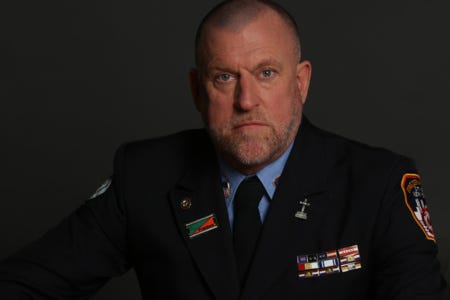
Tim Brown. Photo by Barry Morgenstein
© 2026 Neighbors in Service
If today is one of the hard ones, you do not have to carry it alone.
The 988 Suicide & Crisis Lifeline is available 24/7 by call or text. Veterans, service members, and anyone concerned about them can call 988 and press 1, text 838255, or use the Veterans Crisis Line online chat for confidential support. You do not have to be enrolled in VA health care or benefits to reach out.
For local assistance, Manatee County Veterans Services can help veterans, dependents, and survivors understand and apply for earned benefits, including disability, health care, education, housing, burial, and survivor benefits. To make an appointment, call 941-745-3795.
First responders and their families also deserve support. Florida’s First Responder Resiliency resources include confidential referral support at 206-459-3020, COPLINE at 800-267-5463 for law-enforcement personnel, and free 24/7 crisis-text support by texting 741741.
If someone is in immediate danger or may act on thoughts of self-harm, call 911 immediately.