

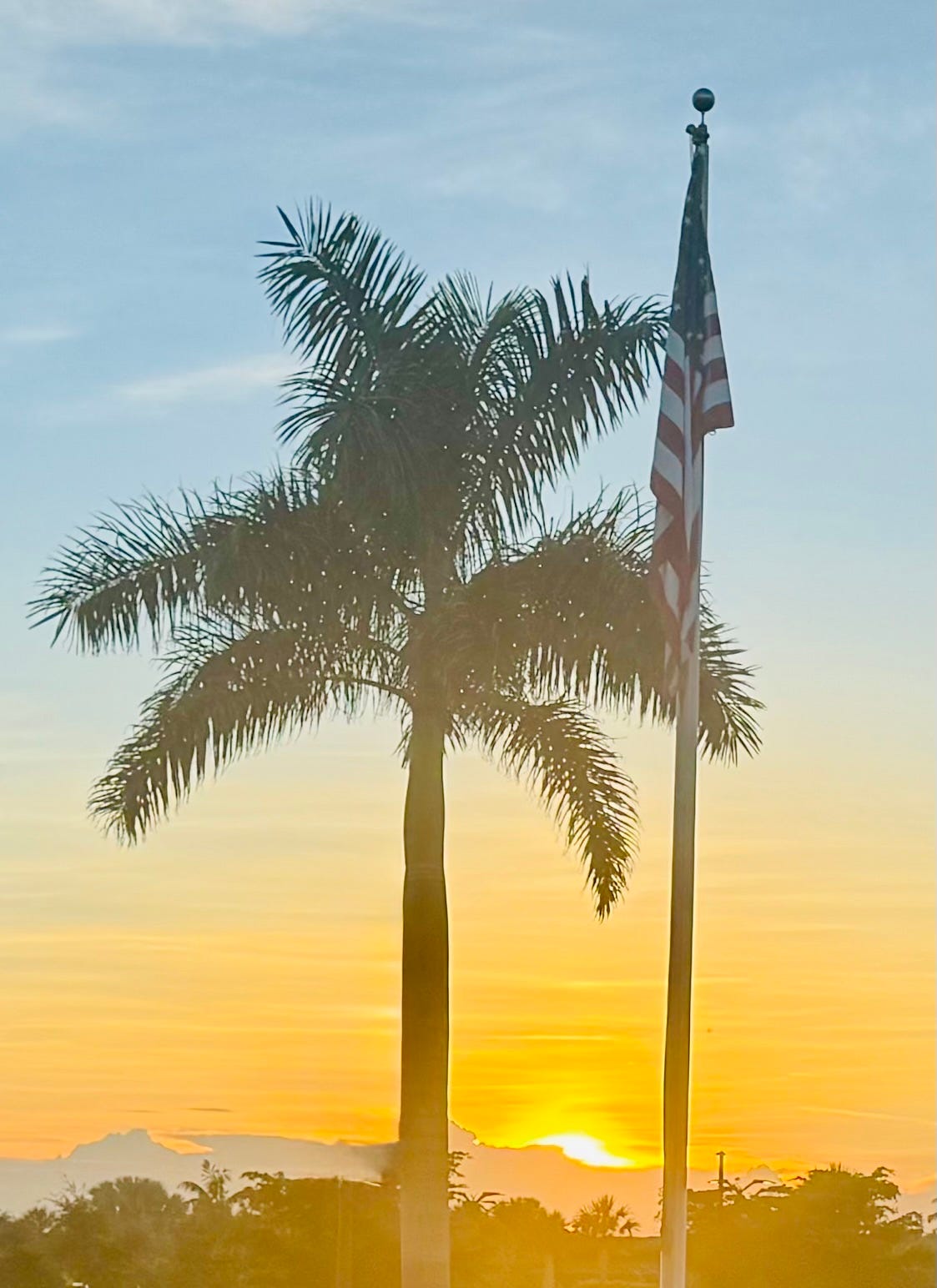
Somewhere in this community, a flag has given everything it had. The Florida sun took its red first.
It hangs from a porch bracket on a quiet street. It has flown through summer storms and Fourth of July mornings, through a Memorial Day or two, through the ordinary weeks when nobody looked up. The stripes have softened to pink. The edge nearest the wind has begun to fray into loose threads. One day its owner takes it down, folds it as carefully as memory allows, and then stands in the garage holding it, unsure what comes next.
That moment of hesitation deserves respect. It means the person already understands the flag is more than fabric. The question is what to do with that understanding.
A CODE WRITTEN BY CITIZENS
For much of our history, no single answer existed. Customs varied from town to town, and the military kept its own practices. That changed on Flag Day, June 14, 1923, when the American Legion convened the first National Flag Conference in Washington. Representatives of nearly 70 patriotic, fraternal, civic, and military organizations gathered to draw scattered traditions into one set of rules for civilian flag courtesy. President Warren G. Harding addressed them. A second conference followed in 1924, and the resulting code spread across the country.
For nineteen years the code lived on the strength of voluntary respect. Schools adopted it. Families learned it. Then on June 22, 1942, with the nation at war, Congress made the Flag Code public law, and an amended version followed that December. The federal code closely followed the rules developed at the 1923 and 1924 conferences. Its etiquette provisions carry no penalties; they still rely on voluntary respect.
For nineteen years the code lived on the strength of voluntary respect.
One provision guides a worn flag’s final day. When a flag has worn past the point of being a fitting emblem for display, the code says it “should be destroyed in a dignified way, preferably by burning.” Today that language sits in Title 4, Section 8(k) of the U.S. Code.
FROM CUSTOM TO CEREMONY
By then, burning was already an accepted practice. What the American Legion lacked was its own official ritual: a way to do it together, in public, with words that matched the moment.
The American Legion supplied that in September 1937. At its 19th National Convention in New York City, the Legion adopted Resolution No. 440, establishing the Ceremony for Disposal of Unserviceable Flags. The resolution’s own preamble is worth noticing. It acknowledged that burning had long been an approved method, yet the Legion had not adopted a ritual to accompany it. It also specifically named flags placed on veterans’ graves for Memorial Day, to be collected afterward, inspected, and retired when worn.
What the American Legion lacked was an official ritual of its own: a way to do it together, in public, with words that matched the moment.
The Legion’s published ceremony calls for an outdoor night gathering. Members stand in two facing rows. A detail carries the worn flags forward for inspection by two vice commanders, then by the commander. The officers ask how the flags came to be in this condition. The answer given is that they wore out honorably, over the graves of the fallen and in places of public service. A chaplain offers a prayer, committing them to the fire and thanking them for the liberty they represented. Members salute as the flags burn.
Seven years later, in 1944, with another generation at war, the Legion’s national convention in Chicago urged wider use of the ceremony and recommended Flag Day, June 14, as the most fitting day to hold it each year. Many posts still do.
WHAT THE FIRE MEANS
To someone watching for the first time, a flag in flames can be jarring. Many of us have seen the flag burned in anger. A retirement ceremony is something else entirely, and the difference lives in everything surrounding the fire: the inspection, the prayer, the salute, the silence.
The Legion’s ritual speaks of the fire as cleansing. That framing helps explain why the tradition has lasted. The flag passes from service into ash, and the people standing at attention are the last ones to see it.
The flag passes from service into ash, and the people standing at attention are the last ones to see it.
The code also leaves room for judgment. Burning is preferred, and the code stops short of requiring it. That matters more now than it did in 1937, when flags were commonly made from natural fibers. Many flags today are nylon or polyester, and burning synthetic fabric can release harmful fumes. National Scouting guidance strongly encourages alternatives to burning synthetic flags, including respectful burial or recycling. The American Legion, however, discourages burying synthetics because they do not biodegrade. If your flag is nylon or polyester, ask the group receiving it how it will be retired with dignity.
A FLAG STILL FIT TO FLY
One popular belief deserves correction. A flag that touches the ground does not have to be destroyed. That idea is a myth. The code says the flag should not touch the ground, but an accidental touch does not require retirement. Its condition determines whether it must be retired. A flag that brushes the grass, or gets soiled, can be cleaned and returned to service as long as it remains a fitting emblem.
The same principle shapes how we care for the flags we place here at Azario. Four times a year, on Memorial Day, the Fourth of July, September 11, and Veterans Day, neighbors line our streets with flags. At the end of the day, we gather those flags and store them for the next placement. We retire them only when they can no longer serve.
That is stewardship in the plain sense the 1923 conference intended. Honor the flag while it serves, and honor it again when its service is done.
Honor the flag while it serves, and honor it again when its service is done.

THE LAST DUTY WE OWE
I find something moving in how this tradition began. Citizens, veterans, and service members gathered existing customs into one civilian code. Veterans, remembering their own fallen, built the Legion’s ceremony, and they specifically included the flags that had stood over graves. Nobody required it of them. They decided it was owed.
That obligation now passes to us. From now through November 12, we are collecting worn and faded flags from neighbors. The evening of November 12, we will deliver them to San Damiano Assembly #3192, Knights of Columbus, for its Flag Retirement Ceremony on Saturday, November 14, at 5:00 PM at Our Lady of the Angels Church. All are welcome.
If you are a veteran or a member of a military family, you know what that flag has meant at a graveside, a homecoming, a deployment send-off. Your presence on November 14 tells the next generation that this ritual still matters. Come stand with us, and bring the flag that has served your household.
If you are a neighbor who has never attended a retirement ceremony, consider this your invitation. Take down the faded flag on the porch or the one waiting in the garage. Send us a direct message or an email, and we will make sure it reaches the ceremony. Then come see for yourself how a community says thank you to a flag.
FLAGS THIS NOVEMBER
Through Thursday, November 12 · Flag collection at Azario. Send me a direct message or email drjack@neighborsinservice.org, and I will collect your worn flag.
Tuesday, November 10 · 8:00 AM · Veterans Day flags go up across Azario. Meet at The Venue.
Wednesday, November 11 · 8:00 AM · Flag placement at Historic Old Memphis Cemetery. A flag at every identified veteran’s grave. Depart from the Wellness Center parking lot.
Wednesday, November 11 · 12:00 PM · Veterans Day Ceremony. Azario Culinary Center Flagpole.
Friday, November 13 · 8:00 AM · Azario flags come down. Flags are stored for Memorial Day.
Saturday, November 14 · 5:00 PM · Flag Retirement Ceremony. San Damiano Assembly #3192, Knights of Columbus, Our Lady of the Angels Church. All are welcome.
Sign up for flag placements on Team Reach, code AZNIS4VETS.
Flags and questions: drjack@neighborsinservice.org
© 2026 Neighbors in Service