

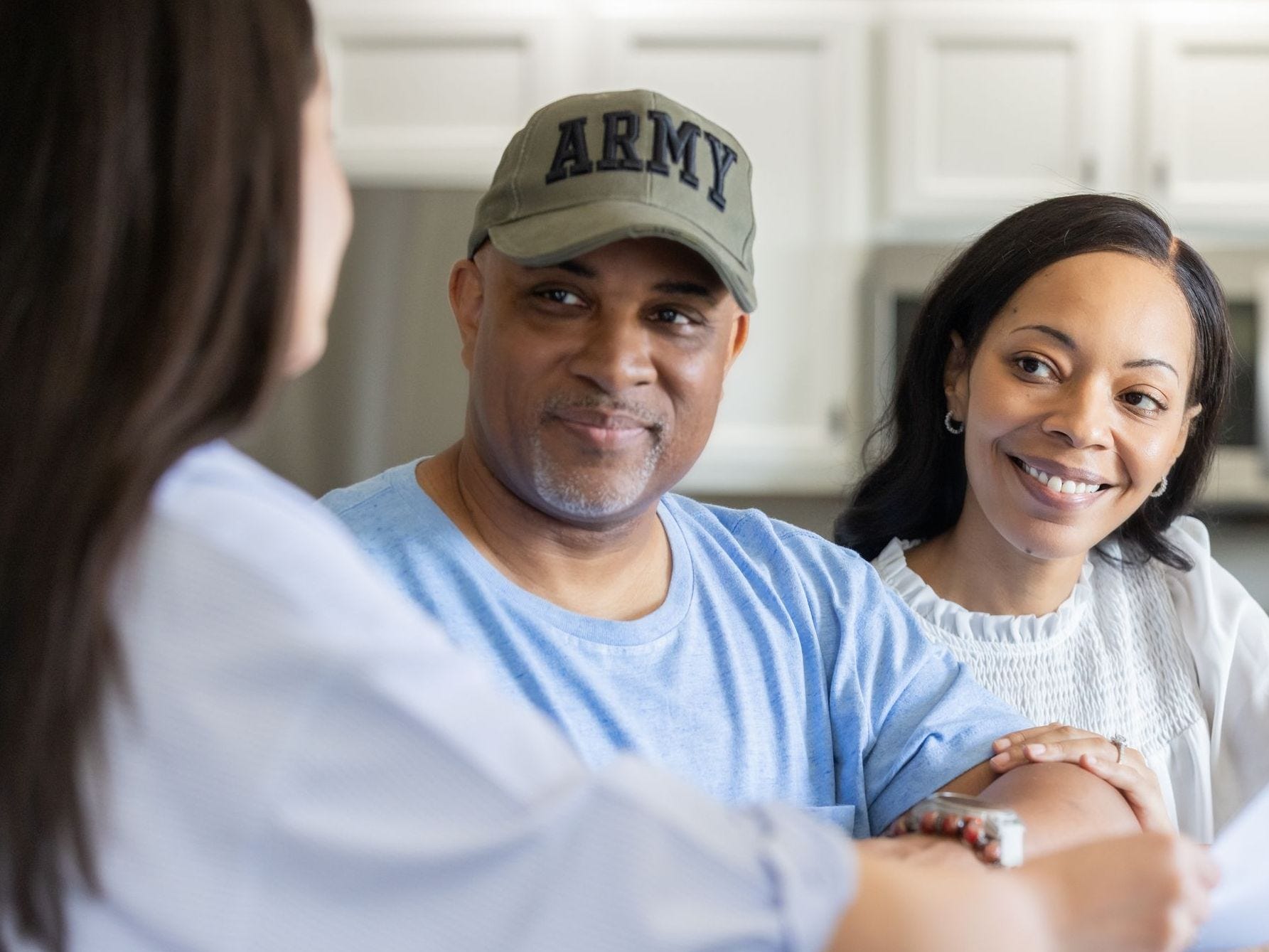
The uniform comes off, the badge goes in a drawer, or the moving truck pulls away for the fourth time in eight years. The next morning, the world looks the same. It does not feel the same.
A retired fire captain sets his alarm for a shift that no longer exists. He gets up anyway, makes coffee, and sits out on the lanai wondering what to do with the next twelve hours.
An Army spouse unpacks the last box in a new rental. Federal law provides a path to have her dental hygiene license recognized after a military-ordered move. Even so, she is still working through the licensing process, and the career she rebuilt after the last move is on hold again.
A Marine, eight months out, has a job, a lease, and a firm handshake. From the outside, he has landed. Inside, the days feel flatter than he expected, and he cannot quite say why.
None of these three would say they are in crisis. Each stands on ground that has shifted beneath them.
Earlier this year, in Someone Who Has Been There, I wrote about the morning a veteran wakes up to a life with no formation and no mission brief. I argued that a mentor’s value comes from standing somewhere the veteran cannot. That article followed veterans through three stages of transition. This one widens the circle. The same morning arrives for military families and first responders, and they often meet it with less support.
THREE KINDS OF CROSSING
When most people talk about transition, they focus on a date on the calendar. They picture the last day in uniform or the retirement ceremony at the station, complete with cake, a plaque, and a few speeches from colleagues who have known you for years. These moments matter, and they deserve recognition. In my experience, though, the real challenges don’t show up on those days. The difficulty often arrives later, after the ceremony ends and everyone has gone home. It affects more people than we usually notice.
For veterans, the military provided structure, purpose, and community in one package. No one had to look for any of them. They often came with the job. Leaving can disrupt all three at once. What surprises many veterans is that they return separately, if they return at all, and on very different timelines. A veteran can land a good job within a month and still be waiting, a year later, for the sense of belonging that once came with a unit. That holds whether someone is entering the workforce, building a venture, or managing a fixed income in retirement. When Mission Roll Call surveyed more than 1,500 veterans and family members in late 2025, half of the veteran respondents said they felt unprepared for civilian life. I read that number as a measure of how much the military was quietly carrying for them.
For military families, transition is constant. Each new set of orders means starting over with jobs, schools, doctors, churches, and friendships. Families are expected to rebuild their lives quickly, often within weeks. Spouses usually carry the largest share of this work. Many start their careers over in every new location. The Defense Department’s 2024 Active Duty Spouse Survey put unemployment among civilian spouses in the labor force at 20%—one in five. When service ends, the family faces one final transition. This time, no receiving unit or assigned sponsor may be waiting to help the family settle in.
For military families, transition is a recurring condition.
For first responders, transition can come through retirement, an unexpected injury, or a quiet decision to move on. Firefighters, police officers, dispatchers, and paramedics build their lives around the job. They share shifts and meals, and they carry a strong sense of who they are when the call comes in. When someone leaves, the crew keeps working. The schedule, the jokes, and the calls continue without them. Some of the support they had on the job may become harder to access once they leave. Families also experience this transition, sometimes with more uncertainty than the responder. A survey cited in a California fire service white paper found that about 11% of spouses, compared with about 5% of first responders, were not looking forward to retirement at all. The person whose daily life changes most may not be the one who wore the badge.
These three journeys are distinct, and you should not treat them the same. However, they share the sudden loss of the structure that once held daily life together. Rebuilding that structure takes time and effort, and the process is rarely smooth. It becomes easier with someone alongside you. That is where a mentor can make a real difference.
WHERE THE GROUND CAN SHIFT
Researchers have spent considerable effort mapping what happens after service ends. A 2024 review in Military Medicine synthesized 43 studies of veterans in transition, showing challenges across several connected areas of life, well beyond finding a job or completing paperwork. I have seen how tightly those areas connect. One person I mentor through American Corporate Partners is the spouse of an active-duty service member, raising children while building a small business from home. She came to our first conversation with a business question: how to grow. It did not stay a business question for long. Any growth plan also had to survive the next set of orders, fit around family life, and be sustainable enough to count on. Work, money, family, and the next move were all part of the same conversation. The same pattern shows up for veterans and for first responders leaving the job. Drawing on that research and our mentoring experience, we use the following seven areas as a practical map, not a diagnostic tool or a reproduction of the review’s categories. The seven areas below name where that ground tends to shift. They describe where things may feel unsettled. They do not describe what is wrong with anyone.
They describe where things may feel unsettled. They do not describe what is wrong with anyone.
I think of this map as the foundation for what comes next. Over the coming months, NIS will cover each area, from financial readiness to food security. Those pieces are written for mentors, and also for any neighbor who wants a clearer sense of what a veteran, a military family, or a first responder may be carrying. Each will point back here, so readers can see where it fits.
Work and career direction. This is usually the first area anyone asks about, and often the one people feel the most pressure to solve quickly. A veteran is translating years of leadership into language a hiring manager recognizes. A military spouse may be restarting her career for the third or fourth time while a state licensing board processes her paperwork. A retired firefighter may be quietly wondering whether anything he knows has a home outside the station. What each is looking for goes beyond a paycheck; they want work that fits who they are now, whether that comes through a new credential, more education, or a business of their own.
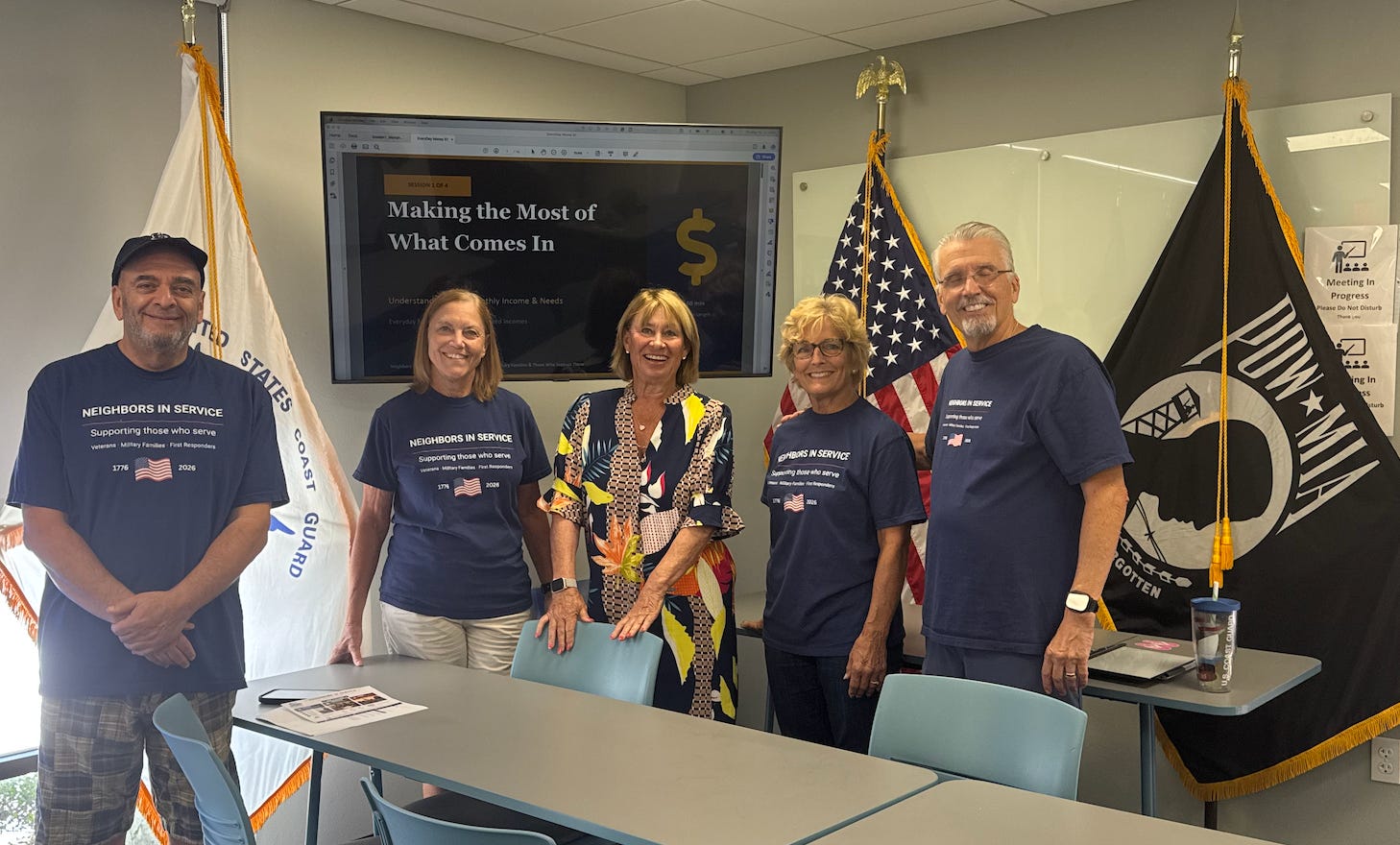
Money and household routines. Money tends to unsettle people quietly. A pension starts later than expected, a benefit changes, or a two-income household becomes a one-income household after a move, and a budget that worked for years stops working. In my experience, clear information and a routine someone can keep up month after month help. That is the work of our Money Check-In Partners: fifteen to twenty minutes a month with a knowledgeable neighbor, offered consistently and with no transaction at the end. Future pieces in this area will cover financial readiness before a move or retirement date, benefits and pension income, and debt management.
Housing and daily essentials. Everything else rests on a dependable place to live. For a family that moves every few years, home also raises practical questions: which address goes on the tax return, which state issues the driver’s license, and where the next set of orders will send them. For a first responder, retirement may bring the freedom, for the first time in decades, to live somewhere other than the community they served. We also include daily essentials, such as reliable food, transportation, and childcare, because people are least likely to mention these needs. Food insecurity can reach households that look stable from the street.
Health and access to care. After a transition, coverage changes, doctors change, and appointments become one more thing to track. Physical and emotional well-being both belong in this conversation. Veterans and first responders may carry the weight of what they have seen for years, while spouses and children carry their own strain from moves and long absences. Some people want to talk about it, and many don't. A mentor respects that choice and knows where to find qualified care when someone is ready.
Relationships and connection. Service and duty come with a community already built around you. Civilian life asks people to build one on purpose. Children start over at a new lunch table. Spouses leave friends behind with every move and begin again somewhere else. A retired deputy may notice that the group text from the old shift, so busy in the first weeks, has gone quiet within a few months. This matters more than it may seem. Research involving Canadian veterans and their spouses has linked stronger social support and community belonging with fewer perceived transition challenges.
Civilian life asks people to build one on purpose.
Identity, purpose, and daily rhythm. For years, a rank, a title, or a badge answered two questions at once: who you were and where you belonged. When it goes, the calendar opens up, and those questions return without an easy answer. Military spouses face their own version, often wondering who they are apart from the next set of orders. Many people eventually find their answer through work, family, faith, learning, or a new form of service. There is no single timetable for finding it. A patient mentor gives them room to keep looking.
Finding your way through systems. This may be the least visible area and, for many, the most exhausting. VA benefits, state licensing boards, pension offices, school enrollment, and community resources each follow their own rules and timelines. Knowing where to begin, and whom to ask, can take more energy than the problem itself. It is also one of the places where a knowledgeable neighbor can help most.
WIDENING THE VIEW
In the first article, I described the core difficulty of transition as a positioning problem. The person in the middle lives inside the picture, so they can't see its shape from where they stand. A mentor helps by standing somewhere else and describing the view. When we widen the circle to families and first responders, the picture holds more people, and some of what matters most happens just outside the frame the person has drawn.
Readers met Renée in the first article. She retired as an Army colonel, made her own crossing into the open work of building something new, and now mentors veterans making that same crossing. One of them, a former logistics officer about a year out, came to her with what sounded like a simple request. He wanted help landing a better job. He had a list of target companies, a revised résumé, and a clear sense of his worth.
Someone Who Has Been There

Editor’s Note: This article explores why mentorship is so critical for veterans navigating civilian transitions. To put these concepts into immediate action, Neighbors in Service has partnered with American Corporate Partners (ACP). You can find direct, trackable links to apply for a professional mentor, volunteer as a mentor, or donate to their mission…
Over their first three conversations, Renée noticed something he had not said. Every role on his list was in another state. Each time she asked about timing, he talked about his own readiness: when his certification would be finished, when he could start interviewing. His wife came up only once, when he mentioned in passing that she had just started a job she liked. He moved past it quickly. To him it was a detail. Renée recognized it from her own first year out, when decisions that felt like hers alone turned out to belong to the whole household.
She did not tell him what to do. At their fourth meeting, she asked one question he had not expected: what would his wife say if the offer he wanted most came through? He had no answer, and he said he would think about it. The following month, Renée came back and asked again.
A retired fire lieutenant in our community plays a similar role for people leaving the fire service. Not long ago, a paramedic who had just retired after twenty-six years called him, mostly to ask about pension paperwork. Midway through the call, the paramedic said the hardest part was the silence: no tones, no radio traffic, no crew around the table at the end of a shift. He said it almost as a joke and went back to the paperwork. The paperwork question took five minutes. The comment about the silence stayed with the lieutenant all day. He did not offer advice. He suggested breakfast the following Tuesday, and then the Tuesday after that, and the breakfast is still on the calendar. A fire service study of retirees points to the same thing: staying connected with people who understand the work softens the loss.
The spouse I described earlier taught me something I now carry into every mentoring relationship. The first goal someone names is rarely the whole story. Renée’s veteran asked about a job, the paramedic asked about paperwork, and in both cases a larger question sat just behind the first. With military families, I now ask early whether a plan will survive the next move. I call it the portability test.
The first goal someone names is rarely the whole story.
The first article took an inventory of what this community already holds. That inventory grows when families and first responders enter the picture. Military spouses who have moved eight times, rebuilt their careers after each move, and know which questions to ask a new school district. Retired firefighters and deputies who remember the first quiet year and what finally helped. Teachers who have welcomed students mid-semester and watched how long it takes to find a seat at lunch. Nurses and benefits specialists who know which office to call and what to say when someone answers. None of them has walked the same road. Each of them brings the one thing that matters most: steady attention over time.
Each of them brings the one thing that matters most: steady attention over time.
MORE DOORS TO KNOW
The first article argued that a good handoff is a skill, and that a mentor’s trust is best spent walking someone to the right door. Widening the circle means a mentor needs to know more doors, and which of them are open.
Some months into those Tuesday breakfasts, the paramedic mentioned he hadn't been sleeping well. Calls he had not thought about in years were coming back at night. The lieutenant did not try to talk him through it. He recognized this was more than a breakfast conversation could carry, and he knew something many retirees don't: his old department’s peer support team would still take the call, even though the paramedic was no longer on the roster. He made the introduction that week and kept the next Tuesday on the calendar. Not every department extends that kind of help to retirees. The California white paper cited earlier warned of a noticeable lack of behavioral health support for retirees. This is why knowing the options matters.
Each person in this article would need a different door. A veteran whose benefits claim has stalled can start with Manatee County Veterans Services or a VA-accredited representative to review the claim, submit supporting material, and identify next steps. An eligible military spouse juggling a relocation, a job search, and a child struggling at a new school can call Military OneSource at 800-342-9647 for free, 24/7 support, including access to confidential, short-term nonmedical counseling. A retired first responder may find help through a department peer support team, an employee assistance program, or a retiree association. Within NIS, our Watch Standers are trained community members who recognize a veteran in crisis and guide them toward help.
If a conversation ever turns toward someone’s safety, the next step is immediate. For a mental health or suicide-related crisis, call or text 988. Veterans, service members, and their loved ones can call 988 and press 1 to reach the Veterans Crisis Line.
WALKING THE CROSSING TOGETHER
The fire captain on his lanai, the spouse unpacking boxes, and the Marine with the flat days are our neighbors. Some of them live on our streets. Some sit near us at church or at the clubhouse. Unsettled ground rarely announces itself, and it rarely fixes itself alone. Renée learned that the most valuable thing she brought was coming back. A steady neighbor who shows up month after month can make the footing firmer.
If you are a veteran, a military family member, or a first responder in the middle of a crossing, you do not need a crisis to ask for a mentor. You only need a question you would like help thinking through. Reach out, and we will listen first.
If you are a member of this community with experience, patience, and a little time each month, consider becoming a mentor. You do not need to have worn a uniform or carried a badge. You need a willingness to listen, to ask good questions, and to know when to connect someone with more help.
Note: Some scenarios are composites drawn from mentoring experience; names and identifying details have been changed.
Contact: drjack@neighborsinservice.org
© 2026 Neighbors in Service
Check out our latest community update.
